10 Signs You're Overscheduled

1. You slip up and forget to follow through on an obligation even though it's on your calendar—which you're too tired to look at before you leave the office.

2. You wake up dreading the day because there's so much to do.

3. You have breakfast—a cup of coffee and whatever is fast and easy and not necessarily nutritious—at the computer because you need to dive right in to the day's tasks.

4. You feel pressed for time so you just skim email and delete rather than take time to actually read and respond.

5. You eat lunch at your desk because you can't take at least 30 minutes away because your computer will explode from the volume of email and social media requests.

6. You long to write more or do something that energizes you and makes you happy but you keep getting sucked in by requests to which you feel you must agree.

7. You long to read more, but never have the time.

8. You never have time to sit and do absolutely nothing except breathe deep and think about how wonderful life is. Even if you're watching TV, you're probably on the laptop or your cell checking social media.
There are 7 days in a week. Learn how to enjoy each one.

9. At the end of the day, you feel depressed because you didn't accomplish enough even though you
worked from sun-up to sun-down.

10. You can't remember the last time you had a leisurely fun day.

Takeaway Truth

If even half of those above are you, then you need to recover your lost life. Get it back.

Delegate and prioritize. Focus on what's most important to do and get that done. Learn to say no. Forget FOMO and reclaim your real life.

Curse of the Blank Page


How can you write when you don't know what comes next?

Do you go blank when you're staring at a blank page or today's equivalent, the blank monitor screen?

Laughingly, it does in movies all the time, but sometimes it does in real life too. Then it's no laughing matter.

Sometimes even when we writers have notes or an outline or some kind of roadmap, we sit down at the computer, lift our hands to the keyboard, and nothing happens. We're blank. Our mind is as clean as a wiped slate.

What do you do then?

You write anyway. Just start writing even if it's something inane and dull. Forget sparkling dialogue, beautiful description, and captivating narrative.

Start by saying out loud, "I want to write about what happens to Jane when Jack rejects her."

Then write. Write sentence after sentence, describing what a character should be feeling or what should be happening or write what you had wanted that scene to be about. As a last resort, write about why you think your brain is blank.

Something Miraculous Happens

I've seen this time and again. You'll fill the page with what you think are just words that mean nothing, but somewhere along the way, the words will start to take form and be germane to the story in some way. Your amazing brain follows through when you give it a task.

Sure, the writing won't be "finished" write, but you know what you do with a page of bad writing, don't you? You save it or print it and put it in the stack of pages if you work that way. You can always fix a page of bad writing, even really bad writing, but you can't fix a blank page.

Nora Roberts is often quoted as saying that very same thing. I doubt if she was the first to state that insight.

I bet every working writer who has earned a living has said or thought the same thing because it's a universal truth about writing for publication.

Rough draft can be edited into finished draft. No matter how awful and pedestrian it may be. Blank pages cannot be edited into anything.

Takeaway Truth

Get the words down. Give yourself permission to write dreck if that's all you can manage. Then refine gold from that dross.

20 Minute Rule Gets You Moving


Do you sometimes have a hard time getting started?

I don't just mean in the morning when you crawl out of bed, but when you're supposed to be dressed and ready to tackle your big project of the day.

For writers, that means being in the chair in front of the computer and writing what needs to be written that day.

I confess that sometimes I just can't get those fingers moving on the keyboard and the words flowing. Sometimes maybe I'm sad because of sad news. I'd rather be doing anything—even cleaning house—than writing.

Writing's my job so I can't afford to idle away the hours mindlessly jumping around social media or cruising the net in search of entertainment.

My 20 Minute Rule

You'll probably think I'm the biggest goof in the world or the most undisciplined, but here's a method I created that works for me. Especially on Monday mornings which are usually the worst morning of the week for me because I often  can't find a dram of enthusiasm no matter how many cups of coffee I drink.

I set my phone alarm for 20 minutes. For those 20 minutes, I goof off. I might channel surf or read some in a novel or play a mind-dulling computer game. I give myself permission to goof off.

When the alarm chimes, I get up and reset it for another 20 minutes. Then I deposit my behind in the chair, open my writing file and dive into whatever I've been procrastinating on. I type away, giving myself permission to write garbage as long as my fingers are moving and words are appearing. I work until the alarm chimes again.

I get up, but this time my mind is awake and my imagination is working. I reset the alarm for 15 minutes this time, and this time I go downstairs and put the laundry on or do some other mundane household chore.

When my alarm sounds, I go back to my computer, reset my alarm—this time for 25 minutes.

When it goes off at the end of 25 minutes, I don't reset it. I'm in the groove. Ideas are flowing. I no longer need the goof off time.

Why This Works

Does it work because I first reward myself first with some goof-off time and follow that with an equal amount of time in which I do something constructive? I don't know.

I do know that even if I don't want to do something, I can hang in there for 20 minutes and do whatever it is.

Twenty minutes seems to be the amount of time needed to get my motivation and energy engaged in a project.


You can do just about anything for 20 minutes if you have a reward at the end. *LOL*

I'll even confess to using my 20 Minute Rule for housework because I'm never enthusiastic about domestic chores.

When I use it for housework, I have to keep resetting the timer.

Takeaway Truth

Sometimes you have to trick the brain into doing what needs to be done. Once you overcome inertia, it's easy to keep going.

The Bridge Between Talent & Success

Today, let's talk about a subject most people don't pay enough attention to because it sounds like, well, hard work.

Many years ago I attended a workshop by Robert Vaughan who has had more than 250 books published under his own name and various pseudonyms—35 names to date.

He's been nominated for the Pulitzer, won the Porgie, the Spur (under the name K. C. McKenna), and was inducted into the Writers' Hall of Fame in 1998.

His novel Brandywine's War was named by the Canadian University Symposium of Literature as "the best iconoclastic novel to come from the Vietnam War."

Brandywine's War at Amazon
Vaughan has written novelizations for television movies and has hit the New York Times and Publishers Weekly bestseller lists more than once. He's also written and produced a one-man play about Ernest Hemingway.

In addition to creating this immense body of work, he's a frequent speaker at high schools, colleges, and writing workshops. All this and he's hosted 3 television talk shows in addition to speaking at seminars, high schools, and colleges.

I give you his credentials in order to make the point that this man knows a lot more about writing and publishing—and staying published—than most of us will ever know.

How has he produced so many words? So many short stories, novels, nonfiction books, plays,  and every kind of writing?

Oh, and he started his writing on a typewriter and only came to computers a couple of decades later.

Work Discipline

His secret is Work Discipline. Allow me to elaborate.

In the workshop I attended, he said if you look at writing talent that it's maybe 15% of writing success. And that might be stretching it.

He then said writing opportunity (going on the internet, finding editors who were acquiring, networking with other writers, etc.) is maybe 10%.

It doesn't take a rocket scientist to see that those two elements make 25% of writing success.

What's the other 75%?

Work Discipline.

Vaughan said, and I agree, that Work Discipline makes up the bigger part of the equation called writing success.

He said to embroider this on a sampler and hang it above your computer.

I think most of you will just print out a sign as I did.

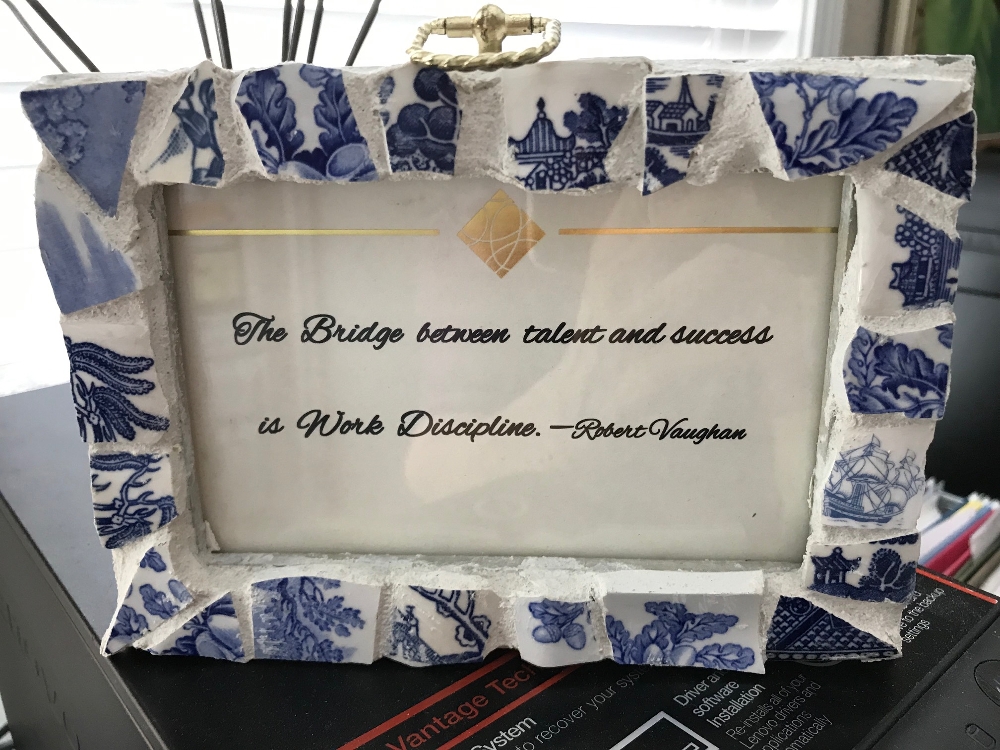
In fact, when I feel hard-pressed to get something written or meet a deadline that seems impossible, I make a new sign and replace the old one that sits on top of my CPU. My sign says:

The Bridge between Talent and Success is Work Discipline.

Frame was a gift from my friend Cheryl Bolen years ago.

Vaughan advocated establishing a daily page quota whether it be 1 page or 10 or more. Every day, produce that page quota.

That's Work Discipline.

That's how he approaches every project. He knows how long it takes him to write a book, and he breaks that down into pages per day.

How many pages a day can you write? Break your project down into how many pages a day you must write to meet your goal. That's your daily quota.

Meet your daily quota come hell or high water. That's Work Discipline.

Do you possess Work Discipline?

Takeaway Truth

You can move a mountain one shovelful at a time. That's the same philosophy you bring to your writing.

You can write the biggest book ever. One page at a time. Or whatever your daily quota might be.

How to Escape a Flooded Vehicle

Tragically, several people died in the flood created by the recent Tropical Storm Imelda.

Especially scary were the stories of people who drove into flooded streets, and, in moments, the water rose to swamp the vehicles and trap them inside.

All of these vehicles had their windows closed, and water pressure can keep a window from opening in cases like this.

Remember, power windows may not work if the engine dies or is inundated with water.

I think all of us who watched the news coverage here in Houston learned an important lesson when we saw a man run to a contractor's truck, grab a hammer, jump on top of a vehicle, and smash the windshield to pull a man out.

I shuddered and knew if that had been me in a flooded car, if I'd been foolish enough to drive into a flooded street, I would have had no way to escape the vehicle if it had been swept away. Nothing in my car would smash a window. Nothing in it could cut a seat belt away.

Get a Plan and an Escape Tool

The Escape Tool

I immediately went to Amazon to look for gadgets that can smash a car window and cut a seat belt. I found several devices similar to the one shown above, and I ordered 2.

The Escape Tool shown is called a Tunery Car Handle, Portable Safety Hammer with Window Breaker, Sustain up to 350 LB Weight.

I want this an escape tool, not to assist me in and out of a vehicle, although this is supposed to do that too. If this item is sold out, check out the other tools that are similar.

Find something to be part of your Escape Plan. When you get it, place it within easy reach, like in the console between seats if your vehicle has that. You want it near enough to grab if you need it.

Accidents happen and floods aren't the only reason you might need to escape a damaged vehicle.

Your Escape Plan

Know exactly what you will do if your vehicle is swept away by flood water. Education is the most powerful tool you can possess.

The best plan is to turn around and don't drive into a flooded street.

Like we're told all the time: Turn around; don't drown.

If you frequently have children with you, make them part of your plan, and make sure they know what to do if you have to activate the plan. Because of backseat passengers, you may want to buy more than 1 Escape Tool.

Older children can take action if they know what to do and when to do it and have a way to escape the back seat. Knowledge is power so include children in the process so they're not terrified but know what to do.

You probably have a home fire escape plan and practice with fire drills. Make this escape procedure the same kind of safety education with drills to practice, saying out loud what must be done.

Above all, make sure your children learn to swim well. It's one of the most important things you'll ever do. I'm a big believer in enrolling children in swimming lessons when they're babies. That's what we did, and all of our kids are good swimmers. Three of our four children took lifesaving classes and worked as lifeguards when they were teens.

If you ignored the best plan and have driven into a flooded street and your vehicle stalls, do these things as quickly as possible.

1. Forget all the stuff you carry in your car. Your goal is to save your life.

Vehicles can be replaced. Stuff can be replaced. People can't. If you have a pocket, drop your cell into it. If you're alone, get yourself out of the vehicle without delay. Hopefully, you'll be able to get out and wade to higher ground.

Take action. Be proactive. Make a Plan. Do it.
2. Immediately unbuckle your seat belt so you can get free.

Seat belts tend to jam when the car cabin is flooded. You'll need to be able to move fast.

If water has already risen and your seat belt won't unbuckle, get the Escape Tool from your console which is where you should have it stored. Use it to saw through the seat belt.

3. Try to open the door and leave the vehicle.

4. If the door won't open, immediately open your window.

If you've lost power, your window may not operate. Use the Escape Tool (remember, it should be close enough to where you're seated so you can quickly grab it). Look away and smash the window. Be fast. Rake all the glass away from the frame. If the water is rising really fast, don't worry about a few cuts. Get out, and you'll be alive to treat the cuts.

Yes, it's scary to think about all that water rushing in, but you'll only escape if you have a way to get out. Keep calm and do what you've rehearsed in your plan.

5. If you frequently have children in the car, you absolutely MUST have a plan in advance.

Being trapped with children in a car in rising water is horrific to think about. But you MUST think about it.

You MUST have a plan to save their lives and yours.

Depending on their ages, you might want to include some kind of child carrier/backpack and absolutely have a way to tether children to you.

Flood water moves fast. Even a few inches of rushing water knock a child down. Get young children into the front seat with you as quickly as possible. Older children should know the same steps you know in order to escape, and they should have access to an Escape Tool in the back seat where they sit.

Secure or tether children to you in whatever way you have planned and get out of the vehicle with them. When you rehearse, time how long everything takes. Every person in your family should go through the drill, reciting the steps out loud.

6. The goal is always to get everyone out of a flooded vehicle and to higher ground as quickly and as safely as possible.

Takeaway Truth

I'm giving one of these Escape Tool to each of our loved ones for Christmas this year.

Serenity Prayer Just for Authors

Reinhold Niebuhr wrote The Serenity Prayer which, in the 1970's was printed on plaques, books, cups, clothes, and anything else wholesalers could think of.

A few years ago I took the thought of Niebuhr's Serenity Prayer and created my own serenity prayer Just for Writers.

I usually print it on cards and send to writing friends at either Christmas or New Year's.

I'm breaking that tradition now because just about everyone I know has had a tough emotional time since January.

So many people I know have family members with serious illnesses. Many have lost a mother, a husband, a brother, a sister, and friends.

Reality of Being a Writer

We're facing change and loss and many of us find it hard to write in the face of all this emotional pain. It's difficult to create fictional worlds and breathe life into fictional characters when all we can think of is the breath leaving the body of someone we love.

Writers draw from the emotional well within. Sometimes, it's just too painful to tap into that well.

We begin to wonder if we'll ever finish the manuscript we're writing. Will we ever get another book contract from an editor?

Will our agent hang in there with us if we're not sending something soon? Will readers forget who we are if we don't publish frequently?

It's bad enough to deal with heartbreak and sadness, and it's made worse when we worry about our cash flow and career.

That's why I'm sharing this with my writing friends today.

Perhaps this bit of wisdom will help you put things in perspective and keep going despite the bumps in your writing road.

A Serenity Prayer for Writers by Joan Reeves

God grant me...

The Serenity to accept rejection of my writing over which I've sweated blood and wept tears.

The Courage to persist and keep writing and revise manuscripts that might do better with editing, better marketing copy, and new covers.

The Wisdom to know the difference between those manuscripts that have a chance of selling well and those that need to be mourned and forgotten.

And also the Wisdom to know when to step back from my writing and take a mental and emotional break to deal with real life. Amen

Takeaway Truth

Always remember that those you love—and the time you spend with them—are of greater importance than any number of words you'll ever write.

Writing Advice: What To Omit

The fabulous Elmore Leonard once said: "I try to leave out the parts that people skip."

That's probably the most succinct piece of advice—and the most profound—that a writer will ever hear.

That philosophy is why Elmore Leonard's short stories and novels MOVE.

If a novel is characterized by rising action, then an Elmore Leonard story moves like a runaway train cresting a hill and racing down.

Does your story do that?

Pull out your work in progress and read 10 pages. Are there parts you skipped over? If you don't have an objective eye, ask an honest reader to read 10 pages. Then ask them if there were sentences or paragraphs they skimmed over instead of reading word for word. If they say yes, then the reason why they skimmed is because those parts were boring.

The Dreaded B Word

What do you do when confronted with an honest reader and the dreaded B word? Immediately figure out if those paragraphs are needed. If they are, condense them as much as possible and make the new copy akin to that speeding train.

Takeaway Truth

Learning what to leave out is as important as knowing what to put in.